

Computing
Computing - Subject Leader Mrs Allchurch

Intent
At Bretherton Endowed CE Primary School, we recognize that technology is an integral part of our pupils' lives and will play a pivotal role in their futures. Our intent is to model and educate our children on how to use technology positively, responsibly, and safely, ensuring they develop into skillful, confident, and creative digital citizens.
We deliver a knowledge-rich, progressive curriculum that seamlessly encompasses Computer Science, Information Technology, and Digital Literacy. Our curriculum intent is underpinned by two core philosophies:
- The 4C’s Framework: We weave Communication, Collaboration, Critical Thinking, and Creativity into the heart of our digital learning.
- Education as Prevention: We believe the best way to safeguard children is through empowerment. We teach pupils that using technology involves making conscious, positive choices, and we actively use our own school platforms—especially social media—to model excellent digital citizenship.
- Equity and Inclusion: We intentionally leverage technology to remove barriers, providing accessible learning opportunities so every child can thrive and express their learning creatively.
Implementation
Our computing curriculum is delivered through a well-resourced, blended learning approach that connects digital skills with the wider curriculum.
Curriculum Delivery & Frameworks
- Progressive Learning: Teachers use Teach Computing and Barefoot Computing to deliver structured, sequential lessons that build computational thinking, coding skills, and technological understanding year on year.
- Cross-Curricular Embedding: Staff are actively encouraged and supported to embed computing across all subjects, ensuring that technology acts as a tool to enhance, deepen, and creatively share learning.
Infrastructure & 1-to-1 Access
- Chromebook Lease Scheme: To support our blended classroom model, we run a lease scheme that guarantees a 1-to-1 Chromebook device for every child from Class 2 onwards.
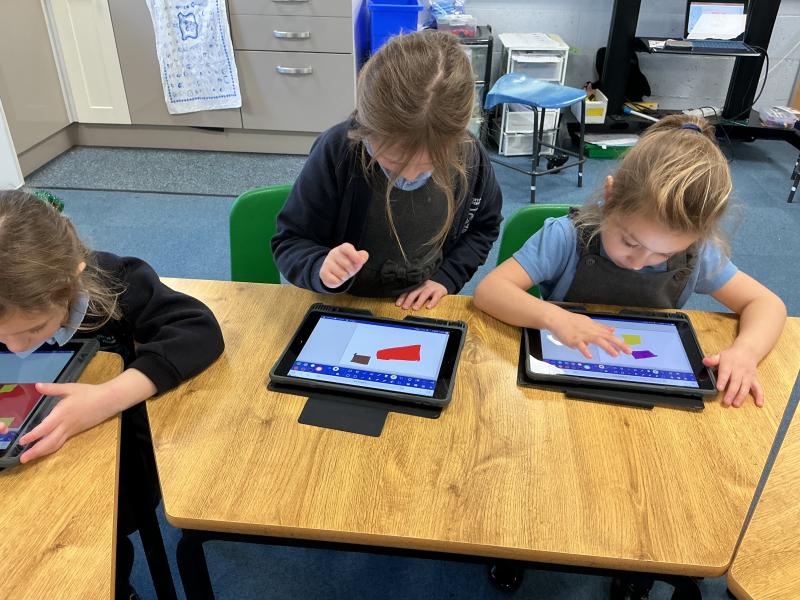
- School Hardware Fleet: This is supplemented by an additional full class set of Chromebooks and two class sets of iPads, ensuring flexible, high-quality hardware is always available.
- Google Classroom Ecosystem: As part of a five-year strategic plan developed with a Google Educator, Google Classroom is fully embedded. It acts as our central hub for setting assignments, digital collaboration, and providing feedback, utilizing Docs, Sheets, Slides, Sites, Earth, and Meet.
A School-Wide Approach to Online Safety
Online safety is never taught in isolation; it focuses on core behaviors that help pupils navigate any platform or device confidently:
- Tri-Layered Teaching: Safety is built into daily cross-curricular lessons, taught in standalone online safety sessions, and reinforced through a school-wide culture.
- Expert Resources: Delivery is supported by the Jigsaw PSHE scheme and the National Online Safety Platform.
Community Partnerships: We regularly invite outside agencies, including the NSPCC and local police, into school to speak with pupils, staff, and parents.
Impact
The impact of our computing curriculum is that pupils leave Bretherton as responsible, competent, confident, and creative users of ICT, fully prepared for the next stage of their education.
- Skillful Computer Scientists: Pupils can confidently apply the fundamental principles of computer science—including abstraction, logic, algorithms, and data representation—to write code and solve complex computational problems.
- Analytical Problem Solvers: Children are equipped to evaluate and apply unfamiliar technologies analytically to solve real-world problems.
- Collaborative Creators: Our pupils demonstrate a high level of digital literacy, regularly using 1-to-1 devices to collaborate with peers, present work innovatively, and articulate their learning through diverse media.
- Resilient & Safe Digital Citizens: Pupils demonstrate a deep understanding of online safety. They recognize that digital behavior is a choice and consistently make safe, positive, and respectful decisions online.
Subject Focus Areas for 2026-27 are:
- Support SEN provision for computing to close the gap identified through data.
- Develop the coding provision in KS2 to include crumbles as well as microbits.
- Assessment to include a portfolio of key units to show what an expected piece of work looks like across the school.
Our Long Term Plan

Files to Download
National Currriculum computing Key learning in computing years 5 and 6 Key learning in computing years 3 and 4 Key learning in computing years 1 and 2 UKCIS_Education_for_a_Connected_World_.pdf Online Safety Progression in the SoW.pdf Computing long term plan 2025.pdf Computing policy 2026.pdf Curriclum.Journey_Primary_2024_2025 (2).pdf